Are Financial "Finfluencers" Giving Misleading Advice? How to Check Their Claims
Finfluencers can make investing look simple, but viral financial advice isn't always reliable. Learn how to verify stock tips, check credentials, identify conflicts of interest, evaluate evidence, and spot misleading investment claims.
Are Financial "Finfluencers" Giving Misleading Advice? How to Check Their Claims
A stock tip appears on your feed.
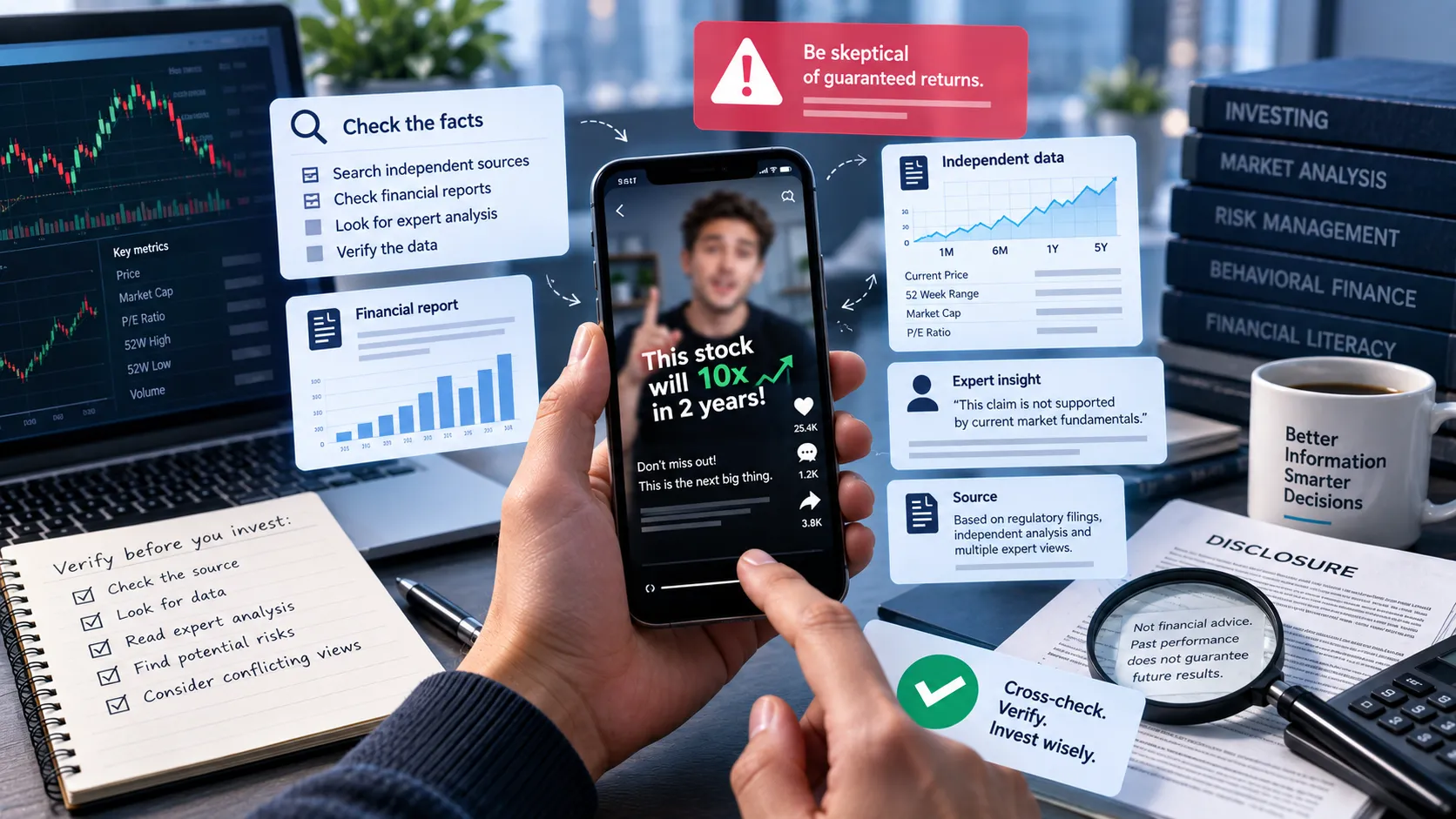
The creator looks successful. Their videos have millions of views. Their comments are filled with people saying they made money. They show screenshots of profitable trades and confidently explain which stock, cryptocurrency, or investment could "explode" next.
It can be tempting to believe them.
But a large following is not proof of financial expertise, and a successful-looking social media profile is not proof that an investment claim is accurate.
Financial influencers, often called "finfluencers," use platforms such as YouTube, Instagram, TikTok, X, and other social networks to discuss investing, personal finance, trading, insurance, cryptocurrencies, and financial products.
Some are legitimate educators who help people understand complicated financial concepts.
Others may present incomplete, exaggerated, biased, or misleading information. Some may also have financial incentives that aren't obvious from the video.
Regulators have repeatedly warned investors about investment scams and misleading financial content on social media. In India, SEBI has specifically identified concerns around unregistered finfluencers and undisclosed compensation, while U.S. regulators have warned investors not to make investment decisions based solely on social media information.
So how do you tell the difference?
The answer is simple:
Don't verify the influencer first. Verify the claim.
What Is a Finfluencer?
A finfluencer is a person who uses social media or digital platforms to influence people's financial decisions.
They may talk about:
- Stocks
- Mutual funds
- ETFs
- Cryptocurrency
- Trading
- Options
- Personal finance
- Credit cards
- Insurance
- Real estate
- Retirement
- Taxes
- Financial products
- Market predictions
Some finfluencers focus primarily on education.
Others make specific recommendations such as:
"Buy this stock before it takes off."
"This stock will double this year."
"Don't buy mutual funds. Do this instead."
"This is the safest investment you can make."
"You can turn ₹10,000 into ₹1 lakh with this strategy."
These statements should not all be treated the same way.
The more specific, confident, and actionable the claim, the more important it becomes to verify the evidence behind it.
Why Can Financial Advice on Social Media Be Misleading?
Social media rewards attention.
A nuanced financial explanation might take ten minutes.
A dramatic prediction can take ten seconds.
That's an important difference.
Consider these two headlines:
"Five factors investors should consider before evaluating a company."
versus:
"THIS STOCK WILL 10X. BUY BEFORE EVERYONE ELSE FINDS OUT."
The second is much more likely to generate clicks, comments, shares, and views.
That doesn't automatically make the prediction false.
But it creates an incentive to make financial content more dramatic than the underlying evidence justifies.
SEBI has identified concerns including finfluencers enticing followers to purchase financial products or securities in exchange for compensation that may not be disclosed.
The Ultimate Finfluencer Verification Checklist
Before acting on a financial claim you saw online, work through this checklist.
1. What Exactly Is the Claim?
Start by removing the hype.
Suppose a creator says:
"This company is going to explode."
What does that actually mean?
Are they claiming:
- The company's revenue will grow?
- Its profits will increase?
- The stock price will rise?
- The stock will double?
- The company is undervalued?
- The company will outperform an index?
These are very different claims.
Write down the specific claim that can actually be tested.
For example:
Vague: "This stock is amazing."
Testable: "The company's earnings will grow by 30% over the next year."
The second claim gives you something to investigate.
2. Check Who Is Making the Claim
Look at the creator's background.
Ask:
- What is their professional background?
- What qualifications do they have?
- Are those qualifications relevant?
- Are they registered with the appropriate regulator when registration is required?
- Do they disclose their business relationships?
- Do they sell financial products or courses?
- Do they earn affiliate commissions?
- Do they have a financial interest in the asset they're promoting?
Don't assume that a creator is qualified because they have:
- Millions of followers
- Expensive-looking videos
- A verified account
- A finance-related degree
- Photos with famous investors
- Screenshots of profitable trades
Credentials should be independently verified.
U.S. investor guidance specifically warns that fraudsters can exaggerate credentials or impersonate legitimate financial professionals.
3. Check Their Registration Status
This is particularly important if someone is presenting themselves as a professional providing regulated investment services.
In India, SEBI regulates investment advisers and other securities-market intermediaries. SEBI has also taken enforcement action against entities providing unauthorized investment advisory services.
For U.S. investors, registration and background information can be checked through official regulatory databases such as SEC and FINRA resources.
The important principle is:
Never rely solely on the registration number or credential shown in a social media bio. Verify it independently through the regulator's official source.
A scammer can copy the identity of a real professional.
4. Ask: "How Does This Person Make Money?"
This is one of the most important questions you can ask.
Imagine an influencer says:
"This is the best trading platform."
How do they benefit if you sign up?
They might receive:
- Affiliate commissions
- Referral fees
- Sponsorship payments
- Advertising revenue
- Subscription fees
- Course sales
- Brokerage-related compensation
- Product commissions
None of these automatically make the recommendation dishonest.
But you should know about the incentive.
A creator who earns money when you purchase something has a potential conflict of interest.
The correct question isn't:
"Are they making money?"
It's:
"Do I know how they're making money, and could that incentive influence what they're telling me?"
5. Look for Disclosures
Check the video description, caption, profile, website, or disclaimer.
Look for statements such as:
- Sponsored
- Paid partnership
- Affiliate link
- Referral link
- Advertisement
- Commission received
- Position held
- Investment disclosure
But don't assume that a disclaimer makes a recommendation trustworthy.
A disclosure tells you about a potential conflict.
It doesn't prove that the underlying financial claim is correct.
6. Ask for the Evidence
If someone says:
"This company is undervalued."
Ask:
Based on what?
If they say:
"This stock will double."
Ask:
What evidence supports that prediction?
Look for:
- Revenue growth
- Earnings
- Cash flow
- Debt
- Valuation
- Industry conditions
- Company filings
- Management guidance
- Competitive position
- Historical performance
- Relevant risks
A serious investment thesis should be possible to examine.
"Trust me" is not an investment thesis.
7. Find the Original Source
Finfluencers frequently refer to:
"A new report..."
"Analysts say..."
"Experts believe..."
"According to research..."
Stop there.
Find the original source.
If the creator mentions a company filing, locate the actual filing.
If they mention research, find the research.
If they quote an analyst, find the analyst's original statement.
If they show a statistic, find where the statistic came from.
This prevents a common problem:
Source → influencer → exaggerated interpretation → audience
By going back to the original source, you remove one layer of distortion.
8. Don't Confuse a Prediction With a Fact
This is one of the easiest mistakes to make.
Consider:
"Company X will increase revenue next year."
That's a prediction.
It isn't a fact.
Likewise:
"This stock is going to 5X."
is a prediction, not established information.
A creator can make an educated prediction.
But they cannot know the future with certainty.
Be especially skeptical of phrases such as:
- Guaranteed returns
- Risk-free
- Can't lose
- Certain winner
- Guaranteed profit
- 100% going up
- No-brainer investment
- Guaranteed multibagger
Regulators consistently identify promises of high returns with little or no risk as major warning signs.
9. Check the Risk
Every investment involves some form of risk.
The potential return doesn't exist in isolation.
If an influencer talks about a potential 100% return but spends almost no time discussing:
- Downside risk
- Volatility
- Liquidity
- Debt
- Business risk
- Market risk
- Regulatory risk
- Concentration risk
you're only seeing half of the story.
A useful rule is:
The bigger the promised return, the more carefully you should investigate the risk.
10. Watch for Cherry-Picked Returns
Imagine a creator says:
"My strategy made 80% last year."
That sounds impressive.
But ask:
- Was this the best-performing account?
- Was the result independently verified?
- Were losses included?
- Were fees included?
- Were taxes included?
- What was the starting amount?
- What was the benchmark?
- Was leverage used?
- What was the maximum drawdown?
- How many trades failed?
- Was this one unusually good period?
Showing winners while ignoring losers can create a completely misleading impression.
11. Be Careful With Screenshots
Screenshots of:
- Trading profits
- Brokerage accounts
- Crypto balances
- Bank accounts
- Luxury purchases
- Profit statements
can be persuasive.
But a screenshot is not independent evidence.
It can be:
- Edited
- Taken out of context
- From a demo account
- Showing only one trade
- Showing unrealized gains
- Missing losses
- Completely fabricated
FINRA has warned about scams in which fraudsters use fake screenshots and manipulated account information to create the appearance of legitimate investment profits.
12. Don't Let Testimonials Prove the Investment
Comments such as:
"I made ₹50,000!"
or:
"This guy changed my life."
can make an investment opportunity look legitimate.
But testimonials don't establish whether the underlying investment is sound.
They could represent:
- A tiny number of successful investors
- Cherry-picked results
- Paid testimonials
- Fake accounts
- People who haven't actually invested
Regulators have specifically warned that testimonials and celebrity or influencer endorsements can be used to promote fraudulent investments.
13. Check the Date of the Information
Financial markets change quickly.
A video from two years ago may still appear in search results even though the situation has completely changed.
Check:
- When was the video published?
- When was the data published?
- Has the company released newer results?
- Has management changed its guidance?
- Has the market changed?
- Has the regulatory environment changed?
- Is the creator still using an old thesis?
Old information isn't necessarily wrong.
It may simply no longer be relevant.
14. Compare the Claim With Independent Sources
Don't search for another influencer who agrees.
Look for independent evidence.
For a stock claim, you could compare:
Influencer claim → Company filings → Financial statements → Regulatory disclosures → Independent analysis → Industry data
If five unrelated sources support the underlying facts, your confidence should increase.
If the only source is the influencer's own video, your confidence should decrease.
15. Look for the Opposing Argument
This is an underrated fact-checking technique.
Suppose an influencer says:
"This company is an incredible investment."
Don't only search:
"Why is Company X a good investment?"
Also search:
"Risks of Company X"
"Company X bear case"
"Company X risks"
"Why Company X could underperform"
This helps you escape confirmation bias.
A strong investment analysis should survive serious criticism.
16. Watch for "Secret Information"
Be extremely cautious when someone claims:
- "I know what's about to happen."
- "Insiders are buying."
- "Big institutions are secretly accumulating."
- "I have information the public doesn't know."
- "This is the next stock to explode."
If the claim relies on supposedly secret information, ask:
How could I independently verify this?
If you can't, don't treat it as established fact.
17. Don't Confuse a Good Investment With a Good Influencer
Someone can correctly predict a stock once and still be a poor source of financial advice.
Likewise, someone can make a wrong prediction without being dishonest.
The real question is:
How reliable is the person's process over time?
Look for a consistent track record rather than one spectacular prediction.
And be cautious about creators who repeatedly delete failed predictions or highlight only successful calls.
A 60-Second Finfluencer Fact-Check
When you're short on time, use this quick checklist:
CLAIM
What exactly is being promised or predicted?
SOURCE
Where did the information come from?
CREDENTIALS
Who is making the claim?
REGISTRATION
Are they appropriately registered when required?
INCENTIVE
How does the creator make money?
EVIDENCE
What data supports the claim?
RISK
What could go wrong?
TRACK RECORD
Can previous claims be independently verified?
CONTEXT
What important information might be missing?
INDEPENDENT SOURCES
Do credible sources support the same conclusion?
If you can't answer several of these questions, don't make an investment decision based on the video alone.
Red Flags of Potentially Misleading Financial Advice
Here are some of the strongest warning signs to watch for:
| Red Flag | Why It Matters |
|---|---|
| Guaranteed returns | Investments involve risk |
| "Risk-free" investment | High-return/no-risk claims are classic warning signs |
| Urgency | Pressure can prevent proper research |
| Secret stock tips | Difficult to independently verify |
| Luxury lifestyle as proof | Wealth doesn't establish expertise |
| Only winning trades shown | Results may be cherry-picked |
| No source provided | Claims cannot be independently checked |
| No risk discussion | Important context may be missing |
| Hidden sponsorship | Creates a potential conflict of interest |
| Fake credentials | Authority may be manufactured |
| "Everyone is buying" | Popularity doesn't establish value |
| "Next 10X stock" | Speculation presented as certainty |
| Push to private groups | Can increase scam risk |
| Requests for money | Requires much greater scrutiny |
Why "Everyone in the Comments Made Money" Isn't Proof
Social proof is powerful.
If hundreds of people appear to agree with a creator, the claim can feel validated.
But comments aren't a statistical sample of investors.
They can be:
- Biased toward people who enjoyed the content
- Manipulated
- Fake
- Influenced by herd behavior
- Missing people who lost money
Social media can create a false impression that an investment is widely accepted or profitable. U.S. investor guidance specifically warns that social media can create false impressions of consensus or legitimacy.
Popularity is not independent verification.
How to Verify a Stock Tip
Suppose a finfluencer says:
"Buy Company X. It's massively undervalued and could double."
Don't immediately decide whether the influencer is right.
Break the claim down.
Step 1: Verify the company
Make sure you're researching the correct company and ticker.
Step 2: Check the financials
Look at:
- Revenue
- Earnings
- Cash flow
- Debt
- Margins
- Growth
Step 3: Check the valuation
Compare valuation with:
- Historical levels
- Competitors
- Industry averages
- Expected growth
Step 4: Read recent company disclosures
Look for new information that might change the investment thesis.
Step 5: Research the risks
Find credible sources discussing why the company could underperform.
Step 6: Evaluate the influencer's reasoning
Does their conclusion follow from the evidence?
Step 7: Decide independently
Don't buy simply because the creator sounds confident.
How to Check Crypto Claims
Crypto content deserves the same level of skepticism.
Be particularly cautious about claims involving:
- Guaranteed yields
- "Next Bitcoin"
- Guaranteed price targets
- Anonymous projects
- Token presales
- Referral programs
- Celebrity endorsements
- Private investment groups
- Requests to transfer funds directly
A large online following doesn't make a crypto project legitimate.
And a chart going up doesn't prove that it will continue going up.
What About Financial Education?
Not all finfluencer content is bad.
In fact, social media can make financial education more accessible.
A creator explaining:
- What an index fund is
- How compound interest works
- What diversification means
- How financial statements work
- What a P/E ratio means
- How inflation affects purchasing power
is fundamentally different from someone telling you:
"Buy this stock today and you'll be rich."
Educational content can still contain mistakes, but specific financial recommendations require a much higher level of scrutiny.
A Better Way to Think About Finfluencers
Instead of asking:
"Can I trust this influencer?"
ask:
"Can I verify this claim?"
That's a much better question.
You don't need to determine whether someone is a good or bad person.
You don't need to decide whether they are a genius investor.
You simply need to determine whether the specific statement you're considering acting on is supported by reliable evidence.
What to Do When a Finfluencer's Claim Looks Suspicious
If you discover that a financial claim is misleading, don't immediately share it with your followers just to expose it.
That can unintentionally amplify the original claim.
Instead:
- Save the original claim.
- Identify exactly what is being asserted.
- Find the original source.
- Compare the claim with the evidence.
- Check independent sources.
- Identify missing context or conflicts of interest.
- Explain what can and cannot be established.
If money is involved, avoid making an irreversible decision while you're still verifying the information.
Use Somiq to Investigate Viral Financial Claims
Short-form financial content often compresses complicated information into a few seconds.
A creator might make several factual claims in a single video:
"Company X increased profits by 40%, institutions are buying it, and analysts expect the stock to double."
Instead of treating that as one statement, break it into individual claims:
- Did profits actually increase by 40%?
- Which period does the number refer to?
- Are institutions actually increasing their holdings?
- Which analysts made the prediction?
- Is the "double" claim a fact, estimate, or personal prediction?
This is where a fact-verification workflow can help.
Somiq can be used to investigate factual claims made in viral short-form content, helping separate what was actually stated from what the available evidence supports.
The goal isn't to tell you what investment to buy.
The goal is to help you determine:
"Is this claim actually supported by evidence?"
The Finfluencer Verification Checklist
Before acting on financial advice from social media, ask:
- What exactly is the claim?
- Is it a fact, opinion, or prediction?
- Who is making the claim?
- Are their credentials relevant?
- Are they appropriately registered when required?
- How do they make money?
- Is there a sponsorship or affiliate relationship?
- Do they own the investment they're promoting?
- Is there an original source?
- Does the original source support the claim?
- Is the information current?
- Are important risks disclosed?
- Are returns being guaranteed?
- Are only successful trades being shown?
- Can previous predictions be verified?
- Do independent sources agree?
- Have you looked for the opposing argument?
- Could acting on the advice cause significant financial loss?
If you can't verify the important parts, don't treat the influencer's confidence as evidence.
Final Takeaway
Finfluencers aren't automatically bad sources of information.
Some provide genuinely useful financial education.
But social media is optimized for attention, not necessarily accuracy.
A creator can have millions of followers and still make a bad prediction. A person can have impressive credentials and still have a conflict of interest. A screenshot can show a real profit without showing the losses. And a citation can be genuine while still being misinterpreted.
The safest approach is simple:
Verify the claim, verify the source, verify the incentives, and verify the evidence.
Before putting your money behind a viral financial claim, ask one question:
"How do we know this is true?"
If you can't answer that question, you're not ready to act on the claim.