Opinion vs. Fact: Why Context Matters More Than a Simple True/False Label
Not every statement online is simply true or false. Learn the difference between opinions, facts, interpretations, and misleading claims, and discover why understanding context is essential for accurately evaluating information on social media.
Opinion vs. Fact: Why Context Matters More Than a Simple True/False Label
Scroll through social media for a few minutes and you'll encounter thousands of claims.
Some are clearly factual:
"The Earth orbits the Sun."
Others are clearly opinions:
"This is the best movie of the year."
But many statements fall somewhere in between.
A creator might say:
"This policy has made life more expensive."
Is that a fact or an opinion?
It depends on what exactly the person means, what evidence they are using, and how the statement is framed.
This is why fact-checking isn't always as simple as putting a TRUE or FALSE label on a piece of content.
A statement can contain a real fact but present it without important context. An opinion can be based on accurate evidence but still remain an opinion. A technically correct statistic can also create a misleading impression when a key detail is left out.
Understanding these differences is essential for navigating information on TikTok, Instagram, YouTube, X, and other social platforms.
What Is a Fact?
A fact is a statement that can be objectively verified or disproved using reliable evidence.
For example:
"India's capital is New Delhi."
This can be checked against authoritative sources.
Other examples include:
- A person's date of birth
- The result of a sporting event
- The population reported in a particular census
- The date a law was enacted
- The published price of a product at a specific time
Facts don't become opinions simply because someone disagrees with them.
However, facts can sometimes be incomplete, outdated, or presented without sufficient context.
That's where things become more complicated.
What Is an Opinion?
An opinion expresses a person's judgment, preference, interpretation, or belief.
Examples include:
- "This is the best smartphone."
- "That movie is overrated."
- "This policy is unfair."
- "This restaurant serves the best food in the city."
These statements may be supported by evidence, but they involve a subjective judgment.
For example:
"This phone has the best camera."
The camera's specifications can be measured objectively.
But "best" depends on what the person values.
Someone who prioritizes photography may reach a different conclusion from someone who cares more about battery life.
Facts Can Support Opinions
An opinion isn't necessarily uninformed.
Consider:
"I think this phone is the best option for photographers."
The speaker might support that opinion with:
- Camera test results
- Sensor specifications
- Lens options
- Image quality comparisons
- Battery performance
The evidence may be factual.
The conclusion is still an opinion.
This distinction matters because fact-checking the underlying evidence doesn't automatically turn a judgment into an objective fact.
What Is an Interpretation?
An interpretation is an explanation or conclusion drawn from available information.
For example:
Fact: A company's sales increased by 20%.
Interpretation: The company's new advertising campaign caused the increase.
The first statement may be directly supported by financial data.
The second requires additional evidence.
There could be many explanations for the increase.
Perhaps:
- The market grew.
- A competitor lost market share.
- Prices increased.
- A new product launched.
- Seasonal demand changed.
The interpretation may be reasonable without being conclusively proven.
What Is a Claim?
A claim is a statement presented as something that can be evaluated.
Claims can be:
- Factual
- Subjective
- Predictive
- Causal
- Comparative
- Misleading
- Unsupported
For example:
"This supplement contains vitamin C."
That's a factual claim.
"This supplement is the best way to stay healthy."
That's largely an opinion or broad recommendation.
"This supplement prevents illness."
That's a health-related factual claim that requires strong evidence.
The wording matters.
Why Context Changes Meaning
Consider this statement:
"Crime increased by 50%."
At first glance, it sounds alarming.
But what does it actually mean?
You need to know:
- Increased from what number?
- Over what period?
- In which location?
- Which crimes?
- Was the measurement based on reports or convictions?
- Was the population changing?
- Is the comparison year appropriate?
Suppose crime increased from 2 reported incidents to 3.
That's a 50% increase.
But the absolute change is only one incident.
The percentage is technically correct, but without context, it can create a misleading impression.
Absolute Numbers vs. Percentages
This is one of the most common examples of why context matters.
Imagine a headline says:
"Risk doubles after using Product X!"
That sounds frightening.
But suppose the underlying risk went from:
1 in 10,000 → 2 in 10,000
The relative increase is 100%.
The absolute increase is 1 additional case per 10,000 people.
Both descriptions can be mathematically correct.
But they communicate very different impressions.
Good fact-checking asks for both.
Context Can Make a True Statement Misleading
This is one of the most important concepts in online misinformation.
A statement can be technically true while still misleading.
Consider:
"Company X received $100 million in government funding."
That could be completely accurate.
But the audience might interpret it as:
"The government gave Company X $100 million in cash."
The actual arrangement might involve:
- A contract
- A loan
- A tax credit
- Research funding
- Multiple projects
- Funding distributed over several years
The original statement may be technically correct, but the missing context changes how people understand it.
What Is a Misleading Statement?
A misleading statement presents information in a way that can cause people to reach an inaccurate conclusion.
This can happen through:
- Missing context
- Selective statistics
- Cropped video
- Misleading headlines
- Cherry-picked evidence
- Incomplete quotations
- Old information presented as new
- Accurate information applied to the wrong situation
Importantly, misinformation doesn't always require someone to invent a completely false fact.
Sometimes what is omitted is just as important as what is included.
Cherry-Picking Evidence
Imagine someone wants to prove that a particular investment strategy always works.
They show five successful examples.
That might look convincing.
But what if there were 95 unsuccessful examples that weren't shown?
The five examples are real.
The conclusion may still be misleading.
This is called cherry-picking: selecting evidence that supports a conclusion while ignoring relevant evidence that points in another direction.
When evaluating a claim, ask:
"What information might be missing?"
Correlation vs. Causation
Another major source of confusion is treating correlation as proof of causation.
Suppose a video says:
"People who drink more coffee live longer, so coffee makes people live longer."
Even if two variables are associated, that doesn't automatically establish that one caused the other.
Other factors could influence both.
For example:
- Age
- Lifestyle
- Income
- Health behavior
- Occupation
To establish causation, researchers generally need stronger evidence than simply observing that two things occur together.
Predictions Are Not Facts
Social media is full of predictions presented as if they were established facts.
Examples:
- "This stock will definitely rise."
- "AI will replace every job."
- "This technology will become the industry standard."
- "This product will make you rich."
These are predictions.
They can be informed by evidence, but the future hasn't happened yet.
A useful fact-checking question is:
"Is the speaker describing something that has happened, or predicting something that might happen?"
Opinions About Facts
People can agree on the underlying facts and still disagree about what those facts mean.
For example:
Fact: A city increased its public transportation budget.
Opinion: "That's a good investment."
Someone else might say:
"That's a waste of money."
The factual premise can be identical.
The disagreement is about values and priorities.
This is why fact-checking should not attempt to turn every disagreement into a factual dispute.
How to Tell Fact From Opinion
Look for certain linguistic clues.
Words Often Associated With Facts
- Is
- Was
- Happened
- Contains
- Measured
- Recorded
- Reported
- Increased
- Decreased
- Costs
These statements can usually be investigated using evidence.
Words Often Associated With Opinions
- Best
- Worst
- Beautiful
- Terrible
- Overrated
- Amazing
- Unfair
- Boring
- Should
- Must
These often involve judgment or values.
But these are only clues.
The word "should," for example, can appear in factual recommendations based on evidence.
Always examine the meaning of the complete statement.
A Statement Can Contain Both Fact and Opinion
Consider:
"The government increased taxes by 5%, which was a terrible decision."
There are two separate components.
Factual component
"The government increased taxes by 5%."
This can be investigated.
Opinion
"It was a terrible decision."
That's a judgment.
A good fact-checker separates the two instead of labeling the entire statement simply "true" or "false."
Break Complex Claims Into Smaller Parts
This is one of the most useful fact-checking techniques.
Suppose someone says:
"This new law is destroying small businesses, increasing unemployment, and making everything more expensive."
That's not one claim.
It's several.
Break it into:
- Did the law change?
- Did small-business closures increase?
- Did unemployment increase?
- Did consumer prices increase?
- Is there evidence that the law caused those changes?
Each question requires different evidence.
This prevents one unsupported part from hiding inside an otherwise accurate statement.
The Importance of Time
Context often depends on when something happened.
A statistic from 2015 may have been accurate in 2015.
That doesn't mean it's accurate today.
Similarly, an old video can be genuine while being misleading when presented as recent footage.
Always ask:
"When was this information true?"
And:
"Is it still true now?"
The Importance of Location
Statistics and claims can change dramatically depending on geography.
Consider:
"Housing prices are falling."
Where?
- A country?
- A city?
- A neighborhood?
- A particular type of property?
A national trend can be completely different from what is happening in a particular city.
Always identify the geographical scope of a claim.
The Importance of Definitions
Sometimes people appear to disagree because they are using different definitions.
Consider:
"Unemployment is falling."
What definition of unemployment is being used?
Or:
"This is a recession."
Different people may use different definitions or indicators.
Before deciding whether a statement is true or false, make sure everyone is talking about the same thing.
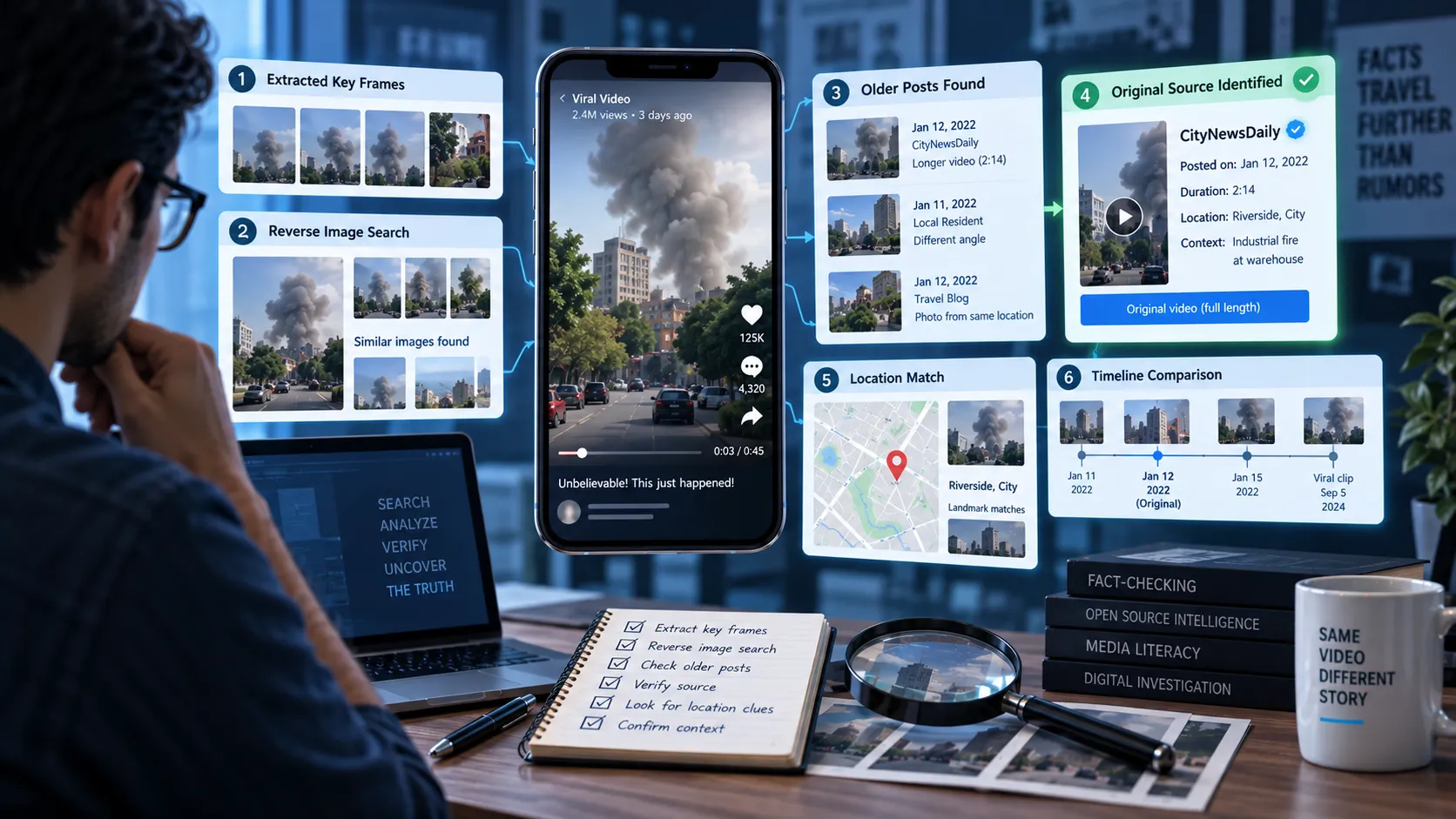
Context Matters in Viral Videos
Short-form video makes context especially important.
A creator may show:
10 seconds from a 30-minute interview.
Those 10 seconds might be completely authentic.
But what happened immediately before or afterward could change the meaning.
For example:
Full interview: "I don't believe this policy will work."
Viral clip: "I believe this policy will work."
If the clip removes the word "don't," the footage may still look completely authentic.
The misinformation comes from editing and context.
How to Verify Context in a Video
When watching a suspicious clip, ask:
Who created it?
Find the original uploader if possible.
When was it recorded?
Don't assume the upload date equals the recording date.
Where was it recorded?
Look for location clues.
What happened before the clip?
Search for the full video.
What happened afterward?
The continuation may explain the situation.
Has the video been edited?
Compare it with earlier versions.
What does the original caption say?
A repost may add a completely different narrative.
Can independent sources confirm the event?
Look beyond the video itself.
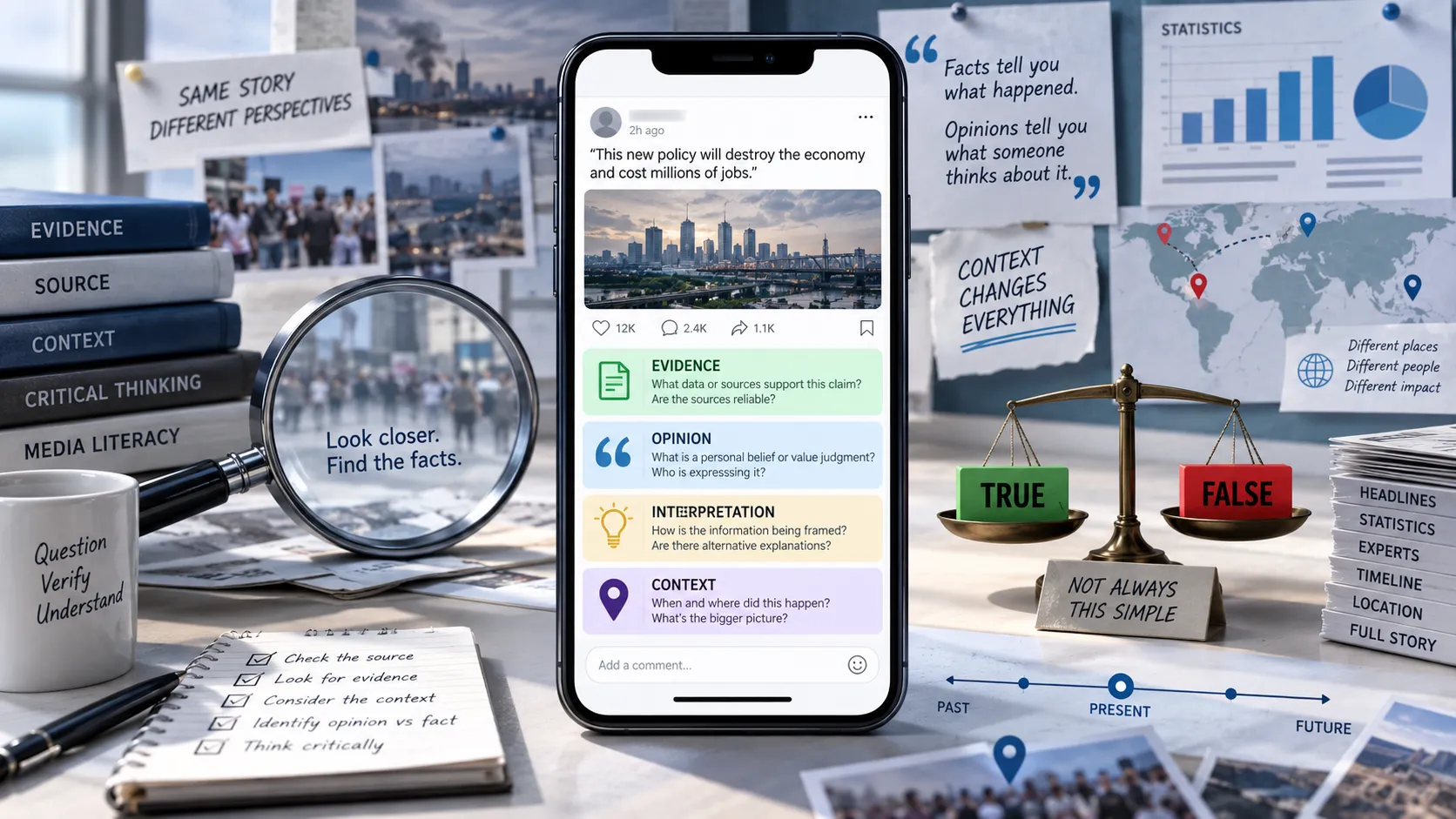
The Context Verification Checklist
Before accepting a claim, check:
- Is the statement a fact, opinion, interpretation, or prediction?
- What exactly is being claimed?
- Can the factual part be independently verified?
- Is important context missing?
- Are statistics being presented fairly?
- Is a percentage hiding a small absolute number?
- Is correlation being presented as causation?
- Is the information current?
- Does the location matter?
- Are important definitions being used consistently?
- Is evidence being cherry-picked?
- Is a video cropped or edited?
- Does the full video tell the same story?
- Can independent sources confirm the claim?
Why "True or False" Isn't Always Enough
A simple true/false system works well for straightforward factual statements.
For example:
"The video was uploaded on March 10."
That can be verified.
But many social media claims are more complicated.
Consider:
"This policy destroyed the economy."
There are multiple questions hidden inside that statement:
- What does "destroyed" mean?
- What economic measure is being discussed?
- Over what period?
- Compared with what?
- What other factors influenced the economy?
- Is the statement a factual claim or an interpretation?
A binary label can hide those nuances.
A better approach is to explain what is supported, what isn't, and what context is missing.
A Better Way to Think About Fact-Checking
Instead of asking only:
"Is this true?"
Ask:
What exactly is being claimed?
Turn vague statements into specific claims.
What evidence supports it?
Look for primary and credible sources.
What evidence contradicts it?
Don't only search for information that confirms your initial belief.
What context is missing?
Look for dates, locations, definitions, and relevant background.
What part is factual?
Separate measurable claims from judgments.
What part is interpretation?
Identify where the speaker is drawing a conclusion.
How confident should we be?
Not every claim can be established with absolute certainty.
How Somiq Can Help
Short-form videos often combine facts, opinions, interpretations, predictions, and emotional commentary in a single piece of content.
That makes simple "true" or "false" judgments difficult.
Somiq helps users investigate claims made in short-form videos by focusing on the specific claims and evidence behind them.
Instead of treating an entire video as one factual statement, a better approach is to break it down:
What is being claimed?
What evidence supports it?
What evidence contradicts it?
What context is missing?
Which parts are factual and which are opinion?
This approach helps users understand not only whether a claim is supported, but also why.
Final Takeaway
Not everything you see online can be reduced to a simple TRUE or FALSE label.
A statement can be:
- Factually accurate
- Opinion-based
- Partially supported
- Misleading without context
- An interpretation
- A prediction
- Technically true but presented in a deceptive way
The goal of good fact-checking isn't simply to attach a label.
It's to understand what was actually said, what evidence supports it, what information is missing, and what conclusion the available evidence justifies.
So the next time you see a viral claim, don't immediately ask:
"Is this true or false?"
Ask something more useful:
"What exactly is being claimed, and what is the context?"
That question often reveals more than a simple yes-or-no answer ever could.