Spotting Health Myths on TikTok: The Ultimate Verification Checklist for Viral Advice
TikTok is full of viral health advice, but not everything you see is accurate. Learn how to spot health myths, verify medical claims, check sources, and avoid believing misleading health advice before sharing or acting on it.
Spotting Health Myths on TikTok: The Ultimate Verification Checklist for Viral Advice
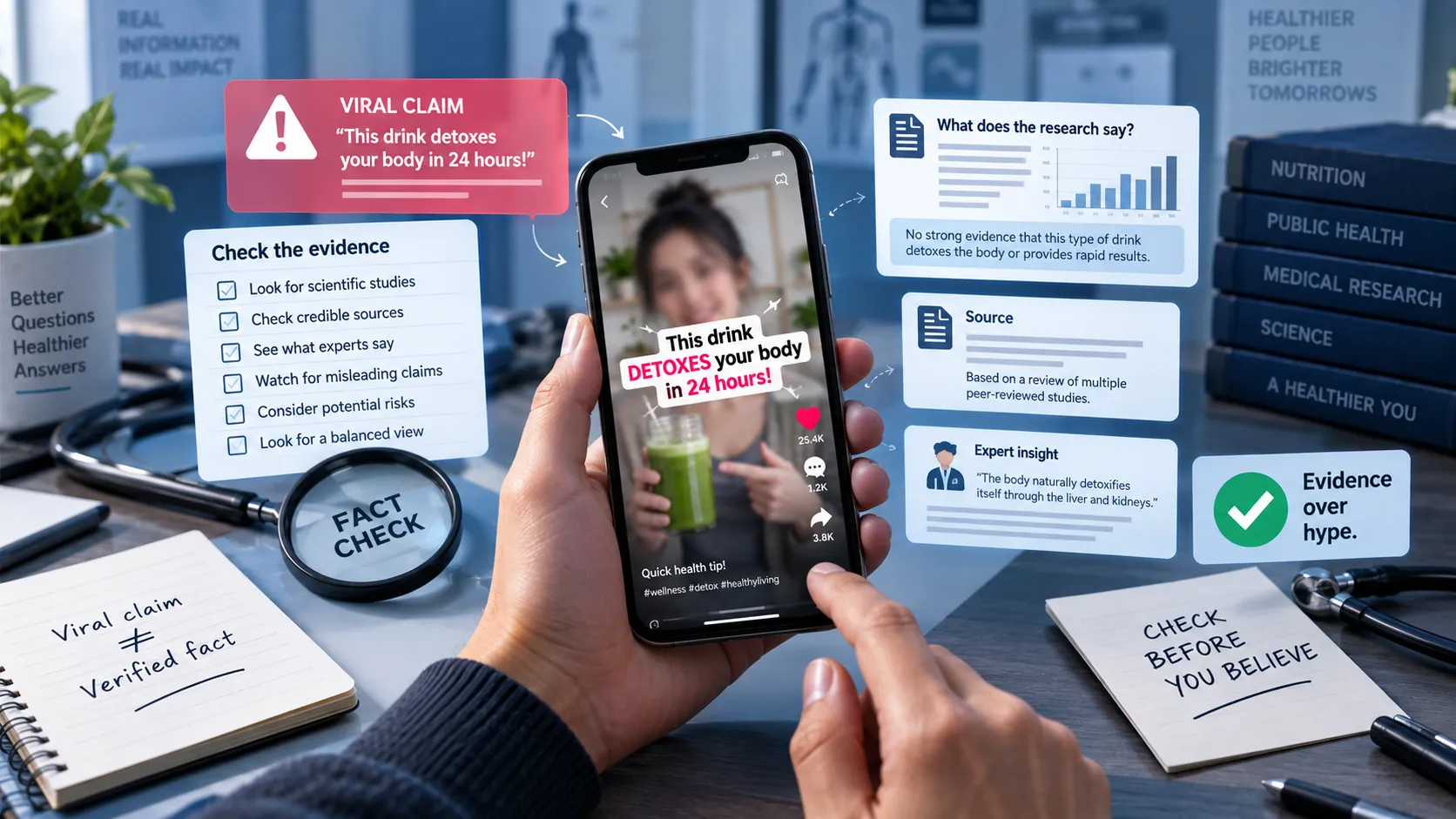
A TikTok video can make a health claim look convincing in less than 30 seconds.
It might promise that a certain food "detoxes" your body, claim that a simple trick can cure a condition, suggest that a common medication is dangerous, or present a personal experience as proof that something works.
The problem is that viral does not mean verified.
Health misinformation can spread especially quickly on short-form video platforms because dramatic claims are easy to watch, remember, and share. A confident creator, impressive before-and-after video, or scientific-looking graphic can make weak evidence appear trustworthy.
Before believing or acting on health advice from TikTok, use a simple verification process.
This checklist will show you how.
Why Health Myths Spread So Easily on TikTok
TikTok's short-video format rewards content that gets attention.
That can create an environment where sensational health claims compete with cautious, evidence-based explanations.
For example, compare these two statements:
"This one ingredient may have some health benefits."
and:
"Doctors don't want you to know that this ingredient can cure your health problems."
The second statement is much more dramatic. It creates curiosity, urgency, and emotion.
That doesn't make it true.
Some common reasons health misinformation becomes viral include:
- Sensational claims: Extreme statements attract attention.
- Personal anecdotes: Someone's experience can feel like proof even when it isn't.
- False authority: A creator may present themselves as an expert without relevant qualifications.
- Cherry-picked research: A study may be real but presented without important context.
- Out-of-context statistics: Numbers can sound impressive while being misleading.
- Before-and-after content: Visual changes can be attributed to the wrong cause.
- Fear and urgency: Claims that encourage immediate action can discourage careful verification.
- Algorithmic amplification: Content that receives strong engagement can reach more people.
This doesn't mean every health video on TikTok is unreliable. It means you should verify important claims before treating them as facts.
The Ultimate TikTok Health Claim Verification Checklist
Use the following checklist whenever you encounter health advice that seems surprising, extreme, or too good to be true.
1. Identify the Exact Health Claim
Before checking whether a video is true, determine exactly what it is claiming.
Don't verify a vague idea such as:
"This video says this food is healthy."
Instead, turn it into a specific claim:
"The video claims that eating this food every morning lowers blood pressure."
That distinction matters because a video can contain a mixture of accurate and inaccurate information.
Ask:
- What exactly is being claimed?
- Is it saying something prevents a disease?
- Is it claiming something treats or cures a condition?
- Is it making a claim about a medication?
- Is it recommending a particular diet or supplement?
- Is it presenting a personal experience as general evidence?
- Does it make a specific numerical claim?
The more specific the claim, the easier it is to verify.
2. Check Who Is Making the Claim
Look at the person behind the video.
Ask:
- What qualifications do they have?
- Are those qualifications relevant to the claim?
- Do they identify their professional credentials?
- Are they selling a product related to the advice?
- Are they receiving sponsorship or affiliate revenue?
- Do they regularly make sensational health claims?
A person can be knowledgeable without being a medical professional. Likewise, having a medical qualification doesn't automatically make every statement they make correct.
The important question is:
Does the person's expertise actually support the specific claim they're making?
For example, someone may be a fitness creator with useful exercise experience but not be qualified to make definitive claims about diagnosing or treating a medical condition.
3. Watch for "Miracle Cure" Language
Certain phrases should immediately make you slow down.
Examples include:
- "Doctors don't want you to know this."
- "This cures everything."
- "One simple trick."
- "The secret doctors won't tell you."
- "Guaranteed results."
- "No medication needed."
- "This completely reverses..."
- "Scientists are shocked."
- "You only need this one ingredient."
- "Big Pharma doesn't want you to know."
These phrases don't automatically prove that a claim is false.
However, they are red flags that the content may be designed to persuade rather than inform.
Evidence-based health information usually involves uncertainty, limitations, individual differences, and context.
4. Look for the Original Source
A TikTok creator might say:
"A new study proves this works."
Don't stop there.
Ask:
Which study?
Look for:
- The study title
- Authors
- Journal
- Publication date
- DOI or other identifier
- Institution conducting the research
- Link to the original research
If the creator doesn't provide the source, search for the exact claim yourself.
This is particularly important when a video uses phrases such as "research shows," "scientists found," or "a Harvard study proves."
A reference to a prestigious institution is not evidence by itself.
5. Don't Confuse a Study With Proof
One of the most common health misinformation techniques is taking a single study and presenting it as definitive proof.
But studies can differ significantly in quality.
Consider:
- Was it conducted in humans?
- How many participants were included?
- Was there a control group?
- Was it randomized?
- How long did the study last?
- Was the result statistically significant?
- Has the finding been replicated?
- Does the study actually support the claim being made?
For example, a laboratory study involving cells does not necessarily prove that the same effect occurs in humans.
Likewise, an observational study can identify an association without proving that one thing caused another.
"A study found..." is not automatically the same as "Science proves..."
6. Check Whether the Evidence Is From Humans
Health claims often move from early research to exaggerated conclusions.
A simplified research progression might look like:
Lab research → Animal studies → Human trials → Larger studies → Systematic reviews
Evidence from one stage does not automatically establish the same conclusion at another stage.
If a TikTok says an ingredient "kills cancer cells," for example, check whether that finding came from laboratory research or actual clinical evidence in humans.
This single distinction can expose many misleading health claims.
7. Search for Multiple Independent Sources
Don't rely on one article, one influencer, or one study.
Look for information from several independent and reputable sources.
Useful places to check can include:
- Government health agencies
- Major hospitals and academic medical centers
- Professional medical organizations
- Peer-reviewed medical journals
- Systematic reviews and meta-analyses
- Public-health organizations
The goal isn't to find another website that repeats the TikTok.
The goal is to determine whether independent evidence supports the claim.
8. Check the Date
Medical knowledge changes.
A TikTok video might be based on an old study, outdated recommendation, or information that has since been challenged.
Check:
- When was the original research published?
- Has newer research been published?
- Has a medical organization updated its guidance?
- Is the video reposting an old claim as if it were new?
A recent video isn't necessarily more accurate than an older one.
What matters is whether the evidence being presented is current and relevant.
9. Look for Missing Context
A claim can technically contain a true fact while still being misleading.
For example:
"This study found that people who consumed X had a lower risk of Y."
That doesn't necessarily mean:
"Eating X prevents Y."
Important context may include:
- The size of the effect
- The population studied
- Other factors affecting the result
- Whether the research was observational
- Whether researchers established causation
- The limitations of the study
When checking a viral health claim, don't just ask:
"Is this statement technically true?"
Also ask:
"Does the evidence actually justify the conclusion this video wants me to reach?"
10. Be Careful With Before-and-After Videos
Before-and-after videos can be extremely persuasive.
Someone may show:
- Weight loss
- Clearer skin
- Muscle growth
- Improved hair
- Reduced symptoms
- Changes in energy
- A recovery story
But a visual transformation doesn't establish what caused it.
Other factors could include:
- Diet changes
- Exercise
- Medication
- Sleep
- Time
- Lighting
- Camera angle
- Editing
- Multiple simultaneous lifestyle changes
- Natural variation
A personal success story can be genuine while still failing to prove that the recommended treatment works for everyone.
11. Separate Anecdotes From Evidence
One of the most important rules for evaluating health advice is:
Personal experience is not the same as scientific evidence.
A creator might say:
"I took this supplement and my symptoms disappeared."
That tells you what happened to one person.
It doesn't establish:
- That the supplement caused the improvement
- That the same thing will happen to you
- That the supplement is safe for everyone
- That there weren't other explanations
- That the treatment works better than alternatives
Anecdotes can be interesting.
They shouldn't be your only evidence for making an important health decision.
12. Check Whether Someone Is Selling You Something
Follow the money.
If someone makes a health claim and then directs you to:
- Buy a supplement
- Purchase a course
- Use a specific product
- Subscribe to a program
- Use their discount code
- Visit their clinic
- Buy a "detox" package
take extra care.
Commercial incentives don't automatically make a claim false.
But they create a reason to ask whether the information is being presented objectively.
A useful question is:
Would this creator make the same claim if there were nothing to sell?
13. Watch for Misleading Statistics
Numbers can make weak claims look scientific.
For example:
"This treatment increases your chances of success by 50%."
That sounds impressive.
But you need to know whether the claim refers to relative risk or absolute risk.
Suppose a risk increases from 2% to 3%.
That's a 50% relative increase, but only a 1 percentage-point absolute increase.
Whenever you see a dramatic health statistic, look for:
- The original numbers
- The sample size
- Relative vs. absolute risk
- The population studied
- The timeframe
- Whether the number applies to you
14. Check Whether the Claim Has Been Debunked
If a health claim sounds familiar but suspicious, search for independent fact-checking or medical reviews.
Try searches such as:
"[claim] fact check"
"[claim] evidence"
"[claim] medical review"
"[claim] study"
"[claim] systematic review"
You can also use a fact-checking tool such as Somiq to help investigate claims from viral short-form videos.
The important thing is to verify the underlying claim, not simply whether someone online agrees or disagrees with it.
15. Watch the Language of Certainty
Real health evidence often contains uncertainty.
Be cautious when a video presents complicated medical topics as absolute facts:
- "Always"
- "Never"
- "Everyone"
- "Guaranteed"
- "Completely safe"
- "Completely toxic"
- "100% effective"
- "Works for everyone"
Health outcomes often depend on factors such as age, existing conditions, medications, dosage, genetics, and individual circumstances.
Extreme certainty deserves extra scrutiny.
A 60-Second TikTok Health Verification Checklist
You don't need to become a medical researcher every time you watch a TikTok.
For a quick first-pass check, ask these questions:
SOURCE
Who is making the claim?
CLAIM
What exactly are they saying?
EVIDENCE
What evidence supports it?
ORIGINAL SOURCE
Can I find the actual study or medical source?
CONTEXT
Does the source really say what the creator claims?
CONSENSUS
Do multiple reputable sources agree?
INCENTIVE
Is the creator trying to sell me something?
DATE
Is the information current?
CERTAINTY
Is the creator making an unusually absolute claim?
ACTION
Could following this advice cause harm if it's wrong?
If you can't answer several of these questions, don't treat the TikTok as established medical fact.
Health Claims That Deserve Extra Verification
Some types of viral advice are particularly important to verify before acting on them.
Medical Treatments
Be cautious about claims that tell you to start, stop, replace, or change a medical treatment.
A social media video shouldn't be treated as a substitute for advice from an appropriately qualified healthcare professional.
Supplements
"Natural" doesn't automatically mean safe.
Supplements can have side effects, interact with medications, and vary in quality.
Diet and Weight Loss
Extreme diets and rapid weight-loss claims can be particularly misleading.
Look for evidence about long-term outcomes rather than relying on dramatic testimonials.
Children's Health
Claims involving children deserve especially careful verification because recommendations can differ substantially based on age and circumstances.
Pregnancy
Pregnancy-related health advice should be checked with reliable medical sources or a qualified healthcare professional before acting on it.
Mental Health
Be particularly cautious about videos that claim to diagnose conditions or promise a simple treatment for complex mental-health concerns.
What to Do When a TikTok Health Claim Looks False
If you discover that a viral health claim is misleading, don't automatically repost it just because you're trying to warn people.
Repeating misinformation can unintentionally give it additional exposure.
Instead:
- Verify the claim.
- Find reliable evidence.
- Check the original context.
- Explain what is inaccurate or missing.
- Share the correction without unnecessarily amplifying sensational misinformation.
And if the claim could affect someone's health, encourage them to consult an appropriate healthcare professional rather than relying on social media advice.
A Simple Example
Imagine a TikTok video says:
"Drinking lemon water every morning flushes toxins from your body and prevents disease."
Here's how you could investigate it.
Step 1: Identify the claims
The video is actually making multiple claims:
- Lemon water "flushes toxins."
- Drinking it regularly prevents disease.
Step 2: Check the source
Who is making the claim?
Are they a qualified healthcare professional? Are they selling a detox product?
Step 3: Look for evidence
Search for clinical evidence supporting the specific claims.
Step 4: Examine the terminology
What does "toxins" mean in this context?
Vague scientific-sounding language can make a claim appear more credible without providing a testable explanation.
Step 5: Check reputable medical sources
Look for independent information about detoxification, hydration, nutrition, and disease prevention.
Step 6: Evaluate the conclusion
Even if lemon water contributes to hydration or provides some nutrients, that doesn't automatically prove that it "flushes toxins" or prevents disease.
This is an important distinction:
A healthy behavior can be real without every claim attached to it being true.
Don't Let a Viral Video Make the Decision for You
The most convincing TikTok health videos often have several things working in their favor:
- A confident speaker
- Strong visuals
- Emotional storytelling
- Scientific terminology
- Testimonials
- Impressive statistics
- Dramatic music
- Thousands of comments and shares
None of these establish whether a medical claim is true.
Before believing a viral health claim, pause and investigate.
Popularity is not evidence. Confidence is not evidence. A personal story is not evidence. And a citation is not evidence unless the underlying source actually supports the claim.
The goal isn't to distrust everything you see online.
It's to develop the habit of asking:
"How do we know this is true?"
Final TikTok Health Myth Checklist
Save this checklist for the next time a health video starts going viral:
- What exactly is the claim?
- Who is making it?
- What are their qualifications?
- Are they selling something?
- Is there an original source?
- Does the source actually support the claim?
- Is the evidence based on humans?
- How large was the study?
- Has the finding been replicated?
- Are there newer studies?
- Are reputable medical organizations saying the same thing?
- Is important context missing?
- Is a personal story being presented as proof?
- Are statistics being used correctly?
- Does the claim use exaggerated or absolute language?
- Could acting on this advice cause harm?
If several boxes remain unchecked, stop before you share or act on the advice.
When it comes to health information, a few minutes of verification can be much more valuable than another viral video.